

Selasa, 26 Februari 2013
Kondisi Atmosferik dan Efisiensi Volumetrik
Kamis, 21 Februari 2013
Characteristic Operation....!!! kinematika Torak/Piston...!!!
Internal Combustion Engine atau diIndonesia dikenal dengan Motor Bakar memang sangat dibutuhkan sekali, bukan hanya menjadi alat untuk membantu aktivitas manusia tetapi juga sudah menjadi gaya hidup... contohnya ya buat balapan lhaa.... GASSPWOOLLL!!!
Piston/Torak yang bergerak pada Internal Combustion Engine mengalami yang namanya Gerak Torak/Piston...

Gambar diatas menunjukkan Gerak Torak Primer, Dimana Gerak Torak Primer adalah Gerak vertikal yg ditentukan oleh tinggi-rendahnya posisi sejumlah titik dari lingkaran engkol.

Gambar diatasini adalah diagram Gerak Torak Sekunder. Gerak Torak Sekunder sendiri adalah Gerak mendatar yang ditentukan dari penyimpangannya dari posisi horisontal.
Dalam sekali putaran poros engkol, batang penghubung berada dua kali pada kedudukan a dan d, dan empat kali pada kedudukan b dan c.
Rabu, 20 Februari 2013
Racing Leather on MotoGp.....!!!

Race leathers provide the first line of defence for competitors
in MotoGP when they suffer the occasional crashes and slides that all
riders go through. With corner speeds quicker than ever and lean angles
becoming increasingly acute the importance of a good set of leathers
cannot be underestimated.
The most common way a rider comes off his MotoGP bike is to lose
control of the front or rear tyre when leaning into a corner. This
usually results in the rider sliding along the asphalt and onto the
gravel at the side of the racetrack, sometimes apparently seamlessly,
though almost always at high speeds. Clearly doing this with exposed
flesh, normal clothing or inadequate leather protection would result in
massive damage to the skin and other parts of the body.
PROTECTION

The various manufacturers supplying the leathers to the MotoGP
participants therefore design the outfits to be as protective as
possible – but they must also be aerodynamic, breathable, comfortable,
durable, flexible, light and water resistant.
The MotoGP leather suits are mainly made of kangaroo leather,
which is more resistant, more flexible and weighs less than cow hide.
The leathers have to provide strong resistance and protection from
abrasion and impact in particularly vulnerable areas such as the back,
elbows and knees - whilst also giving the riders the elasticity they
need when utilizing their lightening quick reflexes.
Of course the riders’ leathers also have to work perfectly in
tandem with the helmets to stabilise the head, so the ‘humped’ back
protectors the race outfits carry fit snugly against the helmets
allowing air to glide over them aerodynamically when the riders are in
the customary hunched riding position. When stood upright and off their
racing machinery the back hump built into the back of the leathers can
clearly be seen, but they are also fairly flexible to allow movement and
bending of the back - in the right direction.
The built-in spinal column protection units and the chest
protectors the leathers also carry mainly use carbon, kevlar and
titanium combinations to safeguard the riders without weighing them
down. Indeed the overall weight of a Grand Prix rider’s leathers will of
course vary in relation to his physical stature, with the entire weight
of the leathers usually totalling around 3kg to 3.5kg
Selasa, 19 Februari 2013
MotoGP Basic...!!! Engines Explanation....!!!


DEFINITIONS

If 2-stroke engines proved more powerful than 4-strokes with similar engine capacities and similar rev counts, 4-strokes engines are more energy efficient and greener. This is because 4-strokes have a dedicated lubrication system, while 2-stroke engines burn a mixture of oil and gas.
As most manufacturers shifted their production towards bigger 4-stroke powered machines, the move to a 4-stroke prototype formula only seemed natural.
The key difference between the two types of engine lies in the combustion process: the four ‘strokes’ refer to the intake, compression, combustion and exhaust movements which occur during two crankshaft rotations per working cycle.
The 2-stroke internal combustion engine differs from the 4-stroke engine in that it completes the same four processes in only two strokes of the piston.
Single cylinder, two cylinder, four cylinder and six cylinder engines - While technical rules restrict the Moto3 World Championship to single cylinder engines and Moto2 to the Official Engine, MotoGP bikes were allowed from one to six cylinders or more up until 2012 when a limit of 4 cylinders with a maximum cylinder bore measurement of 81 mm was introduced.
According to the FIM rulebook, the number of cylinders dictates what the minimum accepted weight of the bike will be, and ballast may be added to achieve it. Due to unit cylinder performance and power-to-weight ratio, all the MotoGP manufacturers opted to use four cylinder engines even before the regulation was introduced.
However, those engines come in different forms, as some manufacturers, such as Ducati, Aprilia and Honda currently opt for V4 architecture, while Yamaha, BMW and Kawasaki have developed ‘inline four’ engines.
With V4’s the cylinders and pistons are aligned separately to each other, so that they take on a ‘V-shape’ from an angle looking along the crankshaft axis. This configuration decreases the total height, length and weight of the engine, in comparison with straight engine inline equivalents.
The choice of engine architecture has as much to do with design philosophy and the manufacturer’s heritage as with weight transfer and goals in terms of bike ‘rideability’.
Meanwhile, the terms 250cc(Moto3™), 600cc (Moto2™), 1000cc (MotoGP™) used to describe the three current categories in the World Championship simply refer to the ‘engine displacement’ or ‘cubic capacity’ of the respective machinery.
Senin, 18 Februari 2013
MotoGp Helmets Explanation.... Let's See...!!
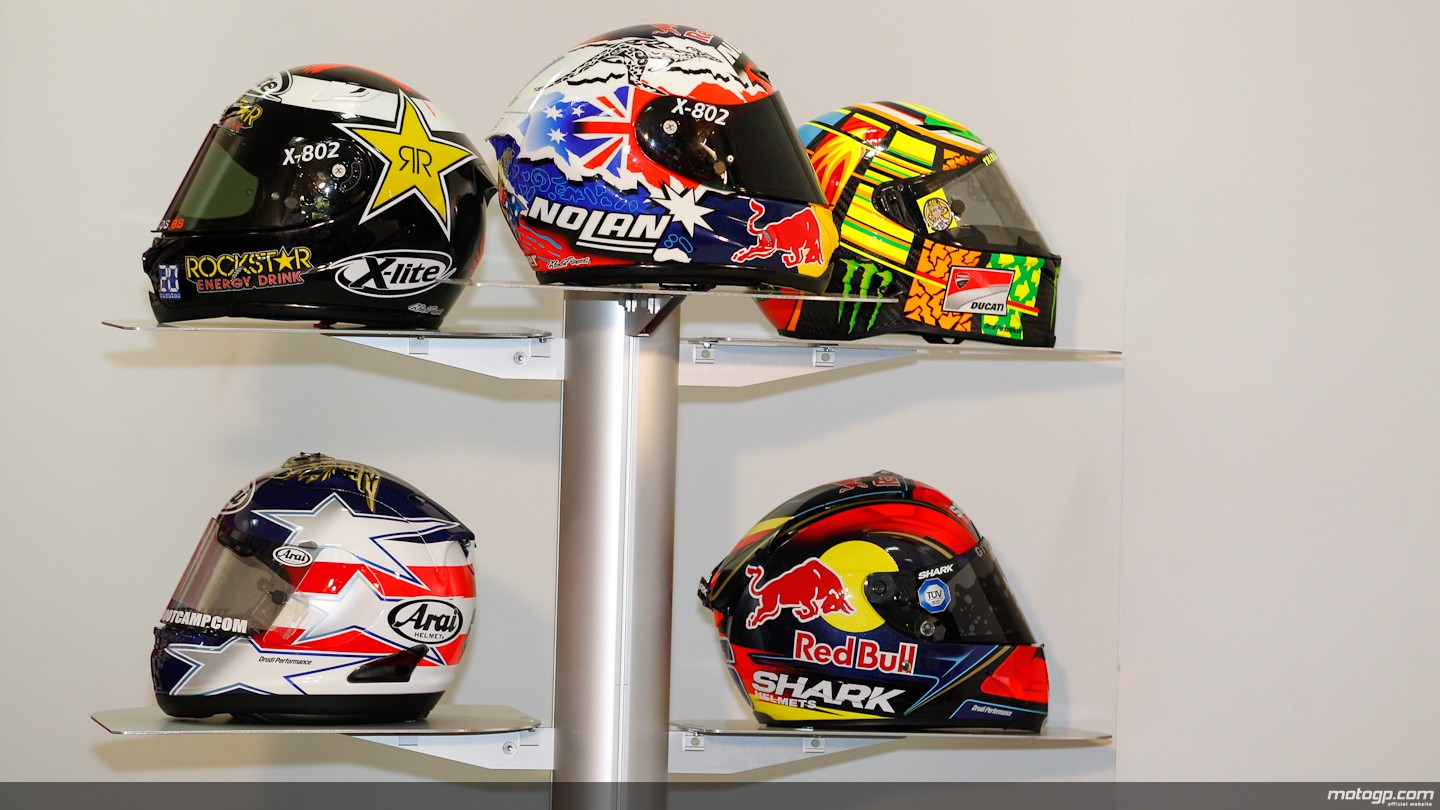
It’s unthinkable that a MotoGP rider would be seen on track
without the most essential of safety items – a good crash helmet. MotoGP
helmets, along with the riders’ boots, leathers, gloves and reinforced
chest and spinal protection pads, are developed to the highest safety
standards with the latest technology.
In a sport where the participants reach speeds of more than 340
km/h, and crashes are a regular occurrence, reliable protective headgear
is of paramount importance for all World Championship competitors.
BASIC STRUCTURE

Racing helmets have the same basic structure as retail helmets
and the specific differences depend on the needs of the rider concerned
in terms of comfort, shape and size. Also, the internal accessories
required may differ, often depending on weather conditions.
For the helmet manufacturers, the MotoGP World Championship -
with its global media exposure to millions of fans - is a great way to
market their helmets, whilst the data they gather from the riders helps
them to improve the products they make available to the public.
Most riders have at least four helmets with them at each event,
with one being rain specific and modified to prevent ‘fogging’ or
‘misting’ and replacements always being required should the main helmet
become damaged.
COLOURFUL DESIGNS

In addition to protecting the lives of the riders, the helmets
they use have become the key element of the riders’ outfits through
which they can express themselves creatively. Many riders have
flamboyant helmet designs reflecting their personalities and tastes.
The distinctive colours and the clarity of the respective race
number or name of the rider on his helmet are essential for
identification by everyone from the race officials and teams to the
commentators and fans – the view otherwise blurred by the intensity and
speed of MotoGP’s busy race circuits.
Langganan:
Komentar (Atom)